Outblast is the latest action game to present players with the opportunity to shoot down hordes of enemies in bullet hell style, but does it do enough to really separate itself from the pack?
Outblast is straightforward in its intentions. Enemies spawn that require blasting, whether they’re snake-like foes that chase you across the map, cubes that emit deadly lasers, or large boss enemies that end each of the game’s five episodes.
Dealing with those enemies is also straightforward. The game’s twin-stick controls encourage players to dart away from foes while simultaneously firing at them. Shots can only be fired straight ahead of the player’s ship, so movement is important both for dodging enemies and lining up shots with them.
There’s also a rechargeable melee attack, and a boost mechanic that can send the player zooming around the playing field. But are those sufficient for differentiation?
Outblast struggles to separate from the shooter games pack
While Outblast does work well enough as a basic shooter, none of its more specific mechanics are particularly outstanding.
Melee attacks feel like they should be big and bold, wiping out anything within close range to give players an edge in exchange for the risk of allowing foes to get so close to begin with. But these attacks are actually pretty tame, not feeling satisfying to use and not having great effect, either.
The boost mechanic provides the player with a way to quickly escape pressure, but you’re just as likely to boost through the side-scrolling screen into something else.
The screen actually scrolls in a continuous loop; the player perspective is essentially in the middle of a ringed playing field, and the player ship then zips around that ring in an effort to find and defeat enemies before a timer expires.
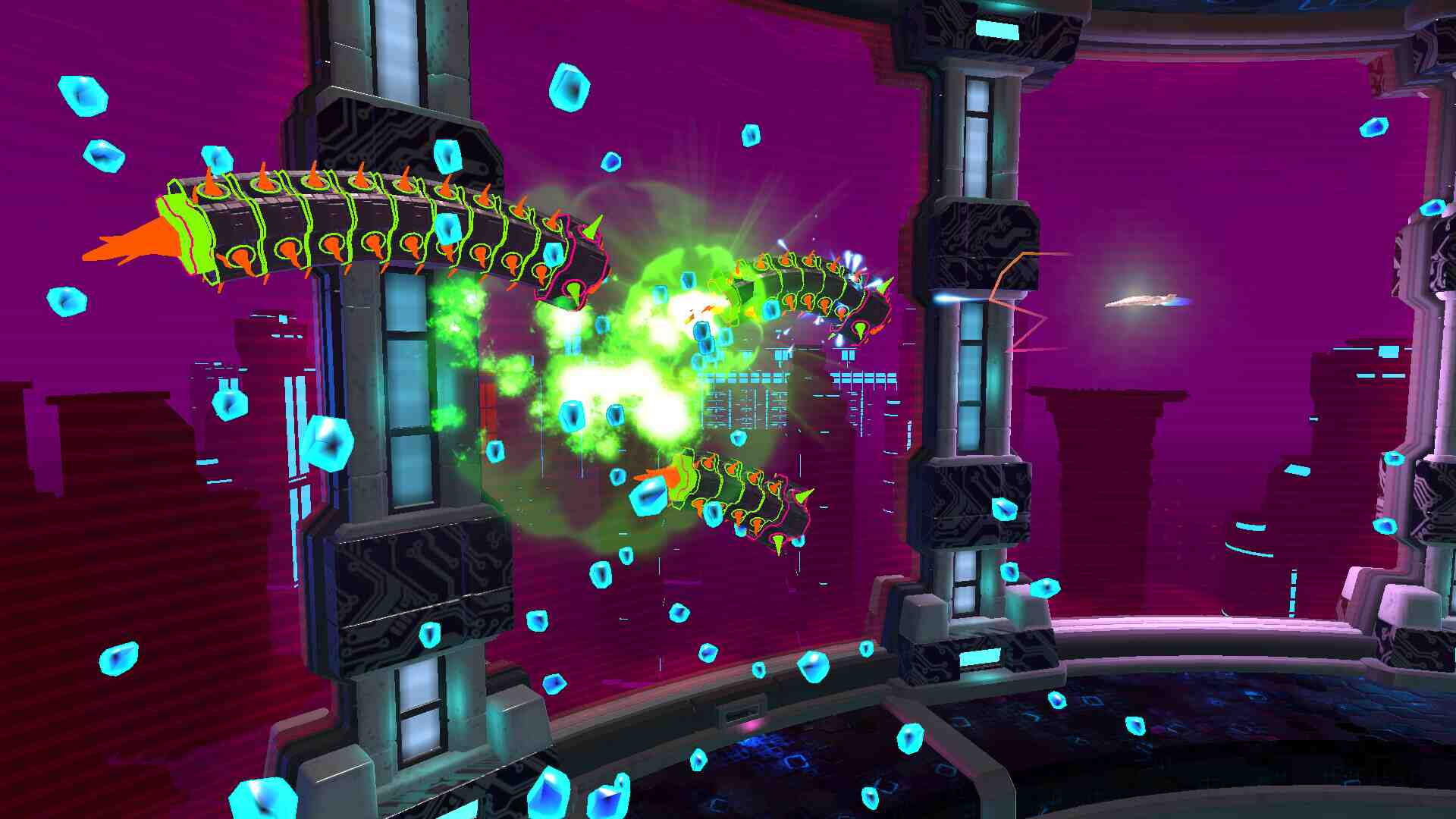
Enemies can be pretty tanky, especially if your weapons aren’t upgraded, and the timer can feel like a burden after the first couple of levels. The game’s biggest frustration may actually be with enemy spawns, as chasing enemies can sometimes warp into the playing field directly next to the player and result in a loss with little time to react.
Boss enemies present the only meaningful variety beyond foes that simple charge at the player or shoot in your general direction, but those encounters don’t actually mix things up in a fun or memorable way. Bosses tend to have a lot of health, and may dip in and out of the playing field, further dragging these encounters out.
A minimal presentation style doesn’t add much to the affair either. The music is forgettable, and the sound effects are even more so.
Outblast does offer VR compatibility, but there isn’t a whole lot to be gained from it besides being able to affect your perspective and perhaps see more of the ring you’re battling across at any given time. Your focus still needs to be on wherever your ship is, and the action doesn’t meaningfully change.
Our impression of Outblast isn’t that it’s a bad game, as its straightforward action is easy to get into and simple to understand. But it does seem to lack much in the way of meaningful features and attributes that might separate it from what’s already a crowded space full of great shooters waiting to be played.
More diversity would have gone a long way towards that end, whether in relation to enemy types, weaponry, or the playing field itself. As it is, it won’t take long for most players to get the full picture of what Outblast has to offer.