

Donkey Kong Bananza represents a dramatic shift in direction for one of publisher Nintendo’s biggest mascots. The days of challenging two-dimensional platforming are temporarily behind him, as developers return Donkey Kong to a three-dimensional platform adventure for the first time since Donkey Kong 64 was released in 1999.
The resulting game has more in common with fellow Nintendo-developed Switch platformer Super Mario Odyssey than it does previous Donkey Kong games, essentially serving as a spiritual sequel to Mario’s last big romp. But is this change in direction a good thing?
The Good:
- Bananza is easy to pick up and feels natural to play
- Lush visuals and great presentation quality
- Destructible environments are fun to punch your way through…
The Bad:
- …But the wall- and floor-punching can grow tiresome, and it’s central to everything
Review Details:
- Reviewed on: Nintendo Switch 2
- Platforms available: Nintendo Switch 2
- Official release date: July 17, 2025
Punch everything, whether you like it or not
The central idea behind Donkey Kong Bananza is that nearly every aspect of the game’s environments are meant to be destructible, and many of those environments specifically need to be destroyed in order to progress through the game.
Nintendo knows how to make a game feel good to play, so it should be no surprise that smashing your way through dirt, rocks, sand, and whatever else is in your way registers well. It’s immediately intuitive, and immediately satisfying, to blast your way through a wall or a floor instead of having to take a more typical platforming route, whatever that might be.

Where Bananza struggles is in just how reliant the game is on this idea. It is a through-line that tracks across the entire experience. Certainly, the game’s varied levels (referred to as “layers,” given that the player is literally cutting down through a planet’s layers in their explorations) offer variety in how the smashing gameplay is implemented. But it can be difficult to shake the feeling of this being another gimmick Nintendo has found and chosen to milk for all it’s worth, rather than paying fuller attention to the game’s core platforming action.
In this way, Bananza can be a similar experience to Super Mario Sunshine. A game bristling with quality design, but perhaps limited by being almost fully reliant on its chosen gimmick. Rather than Sunshine’s water jet, Bananza has Donkey Kong’s fists.
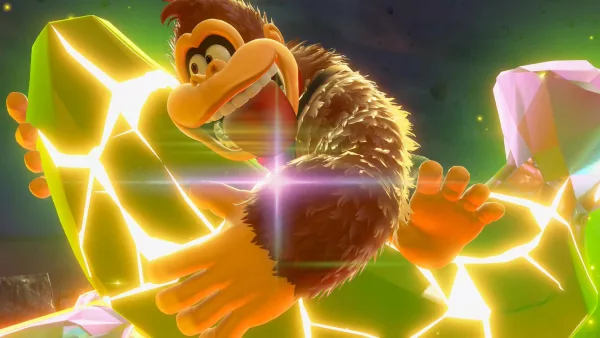
There is some additional variety provided by the various animal transformations the player learns over the course of the game, but these are better thought of as hammers that can smash through the game than careful additions that create new gameplay opportunities. If anything, the transformations can dull the game’s challenge, and it’s often more fun to purposefully forgo them and try to do without.
Importantly, the game never outright feels bad. But it can begin to feel like a grind, particularly for players who are interested in tracking down a good number of the game’s 777 banana rewards. That’s a lot of walls to punch through.
That fresh Nintendo scent
It’s unsurprising that Bananza is buoyed by quality production. If nothing else, Nintendo can just about always be relied on for their first-party games looking and feeling like strong work, and that’s certainly true for Bananza.
The game’s layout, the way its NPCs exist and interact with the player, and the general audio-visual presentation all make clear that Donkey Kong Bananza’s roots lie with Super Mario Odyssey, despite the differences between the two games. Bananza does look better, taking good advantage of the Switch 2’s increased hardware capabilities.
One minor quibble is related to DK’s fur. While it’s lovingly rendered, it’s often a different, much brighter color than intended. This is because Kong’s fur is highlighted when he fills up with the banana power used to enable his various transformations, but that power is so abundant that DK is almost always so highlighted. It’s a small thing, but was noticeable enough that it seemed strange Nintendo didn’t better resolve it.
There’s also a story here, though most players won’t much remember it beyond the time it takes to play through the game. Established character Pauline is reintroduced as a child who accompanies DK through his journey, and there’s a bit of a character arc provided for her, but it’s minimal and borders on perfunctory.
The Bottom Line: Donkey Kong Bananza represents the quality production Nintendo first-party games are known for and its wall-smashing gameplay is good fun, but the full experience eventually stretches its central components thin.
Score: 8.0/10


